
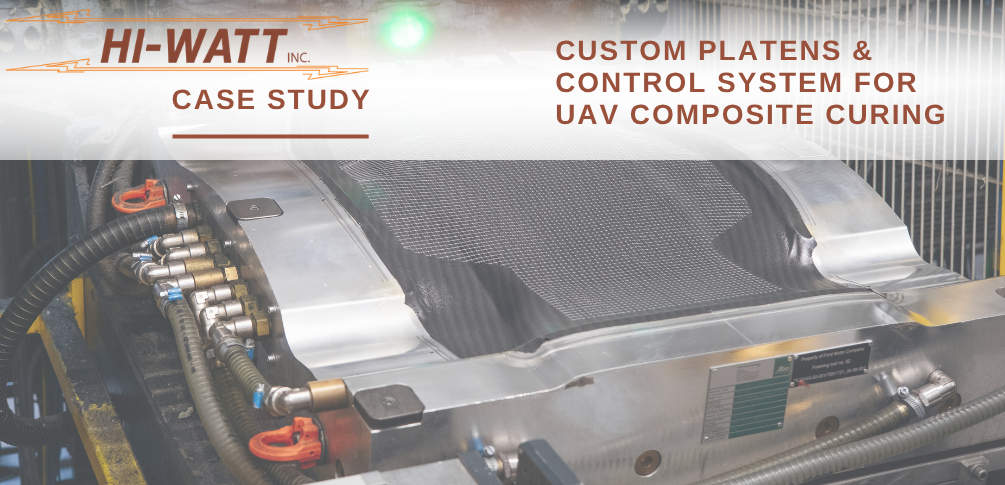
Hi-Watt Delivers Custom Platens & Control System for UAV Composite Curing
Carbon fiber composites are critical in UAV design, dominating everything from fuselage shells to motor arms. The quality of these components is determined by many factors, including the cure that finishes it. A poorly designed process heater (along with inadequately tuned controls and bad sensor placement) can contribute to under curing, voids, dimensional issues, or inconsistent part quality.
Composite curing requires careful coordination between heater design, sensor placement, control zones, and ramp-rate management.
The Challenge
A West Coast composite manufacturer won a new UAV component program and needed to increase production capacity quickly. Hi-Watt was brought in to help specify a turnkey system that could help them build a repeatable thermal process for curing carbon fiber parts.
Our Solution
We determined that the client needed four heated platens, along with a four-zone control panel to meet their application requirements. All work was performed in-house.
We started by calculating the appropriate watt density for each platen. Many process heaters fail early because they’re not sized to the application. We looked at the components being manufactured, the composite systems being cured, surface area, required ramp rate, and operating conditions. The heated platens were also machined to match the contour of the parts being heated. Contact area is where many platen designs lose uniformity; the custom machining provides better surface contact and eliminates air gaps that cause poor heat transfer and hot or cold spots.
The sensor strategy was next. Platen temperature leads part temperature, so we identified sensor locations that gave the controller a better representation of what the laminate actually sees.