
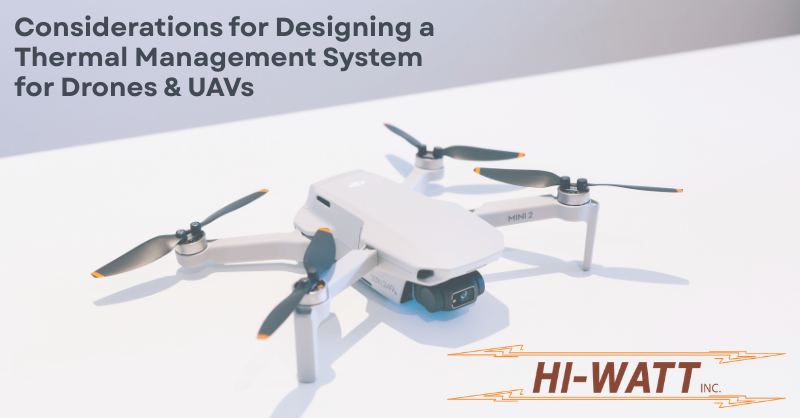
Considerations for Designing a Thermal Management System for Drones & UAVs
Cold creates three main challenges for Unmanned Aerial Vehicles (UAVs): 1. It reduces battery life, 2. Causes condensation in optics and electronic enclosures, and 3. Leads to icing of control surfaces and actuators.
The solution is to install heaters, along with active and passive cooling systems. The problem is that in lightweight drones, every ounce, watt, and cubic inch must be used as effectively as possible, and that heaters significantly impact battery life.
Thermal management in drones can also extend to the payload, particularly in civilian applications. Drones ferrying medical supplies and biological samples are a good example, as they often need to keep the payload within a narrow temperature window. In such cases, payloads may need heating, cooling, and insulating.
When designing thermal management systems for drones and other UAVs, a comprehensive application review is required that takes the following into account:
Size & Geometry of UAV
Fixed-wing, multi-copter, and VTOL drones come in many sizes and shapes, which complicates heater installation.
The top priority for maximizing heat flow is thermal contact, or the effectiveness with which heat is transferred from one surface to another. The issue is that uneven and rough surfaces create gaps that slow the rate of heat transfer.
Flexible heaters, often produced from polyimide, can conform to curved surfaces and are available in custom-tailored shapes, allowing greater flexibility in UAV component design. Fixing these heaters securely to smooth flat or curved surfaces and using thermal interface materials to maximize conductivity helps improve efficiency and has the smallest impact on battery life for the thermal energy provided.
Weight
Heating and cooling devices must maximize output per ounce of weight. For delivering localized heat, flexible heaters are often the best option. Some heating solutions use supercapacitors rather than batteries to provide short but intense bursts of energy.
For insulation, aerogel foam is extremely lightweight and provides excellent thermal protection. Two options for cooling are phase change materials (PCMs), which use heat to move between solid and liquid states, and thermoelectric (Peltier) cooling.
Environment/Chemical Exposure
Drones are deployed in environments ranging from hot deserts to places with heavy rain, high humidity, and low temperatures. Ice build-up is a particular concern, but they can also be attacked by dust, particulates, and salt spray, experience high levels of vibration, rapid acceleration and deceleration, and may even have to undergo disinfecting and chemical cleaning before and after use. Additionally, in some applications, radio-frequency (RF) emissions can be a concern.
Collectively, these potential hazards create challenges for heating and cooling devices, especially those with moving components and seals.
For aerospace components, the RTCA DO-160 test standard (“Environmental Conditions and Test Procedures for Airborne Equipment”) is sometimes used to evaluate the ability to handle environmental and chemical challenges. When selecting or specifying components for thermal management in drones, consider specifying their use or application.
Mounting Preferences
Heating and cooling devices need to be mounted in ways that allow for expansion and contraction while also supporting rapid replacement if needed. Direct bolting to the frame or drone structure is often preferred, with a thermal interface material between the two surfaces. However, this does add weight.
An alternative to bolting is to use mechanical clamps, which have the advantage of being quickly opened and closed, but again, they add weight.
An alternative is adhesive bonding. Small resistive heating elements may be adhesively bonded to elements such as wing edges and around camera optics. This is lighter than using mechanical fasteners, but makes it harder to replace components.
Needed Wattage
Batteries are heavy, so every electrical need on a UAV must be minimized to shrink capacity as much as possible. A drone heater can account for a significant portion of the total electrical demand, which makes energy conversion efficiency one of the top considerations. It’s also why supercapacitors may be considered in certain designs because they provide short bursts of power when needed.
When calculating the wattage needed, it’s essential to include safety allowances to account for performance degradation over time. Also, seek out solutions that provide the greatest stability over time, regardless of operating conditions.
Cycling Requirements
Drone hardware undergoes thermal, environmental, and mechanical cycling while in use. The impact of all of these must be considered during the design phases.
Thermal cycling is an issue because many of the components used have different coefficients of thermal expansion, leading to relative movement that can squeeze out thermal interface materials and cause distortion.
Environmental and mechanical cycling also impose varying loads on thermal management components, resulting in high intermittent loads and short periods of especially adverse operating conditions.
An additional factor to consider is power cycling. Many of the heat sources on a drone only operate intermittently, and their temperatures may rise and fall quickly. Consequently, heating and cooling devices must provide the fast response needed to prevent in-flight problems.
Acoustic Needs
Some applications require drones with a low acoustic signature. Thermal systems using fans and pumps can contribute to the total sound output. In contrast, resistive heating and passive cooling devices operate soundlessly, making them good choices.
Modularity for Payload Swaps
Drones built to carry payloads, as opposed to those built for surveillance/reconnaissance, often incorporate heating and/or cooling systems. If the payloads are interchangeable, heat loads and required temperature windows may vary.
To address this, consider ways in which thermal management components can be quickly adjusted to suit. Clamps and modular/quick release fittings are usually preferred choices.
Maintenance Requirements
Drones are vulnerable to damage in the field, especially from hard landings. There is also the possibility of thermal components deteriorating and requiring replacement due to environmental factors.
The ability to maintain thermal systems in the field should form part of the design considerations. UAVs should be designed with easy access to the components most likely to need replacing, and appropriate mounting methods should be considered.
Hi-Watt Is Ready to Solve Your Thermal Challenges
UAV thermal management usually requires custom solutions to meet the challenging demands of weight, space, and performance. Hi-Watt is a turnkey thermal solutions provider that can help customers source and configure heaters, sensors, and process controllers to meet the most difficult requirements.
Partnered with leading brands like Watlow/Eurotherm, Tempco, Nexthermal, and Convectronics, we have the resources and expertise to build custom heaters that optimize efficiency, reliability, and performance. Contact Hi-Watt today to discuss heater, sensor, and control requirements for UAV or lightweight thermal-management applications.