
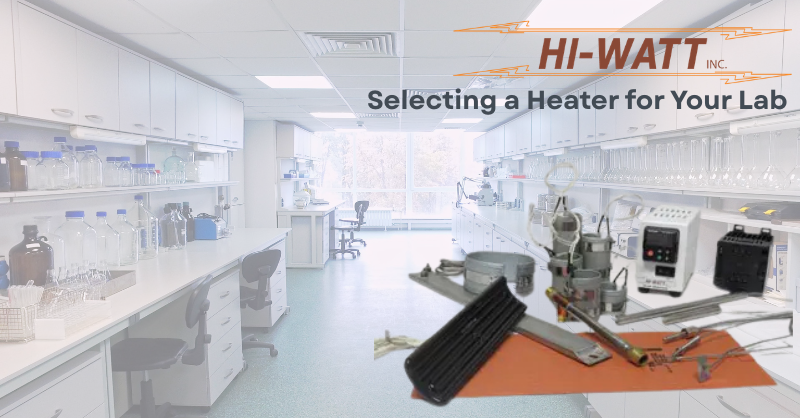
Selecting the Right Heating Technology for Lab-Scale Testing
Selecting the right process heaters for test labs begins with understanding the application, not just choosing a heater style. Flexible rubber heaters, immersion heaters, circulation heaters, tubular heaters, cartridge heaters, and band heaters are all great options, but there isn’t a universal heating solution. Application matters, along with the desired temperature range and the medium being heated.
Before you make any investment, ask yourself these questions:
What Are the Thermal Demands of Your Application?
Start with the total heating required for your process.
Some lab applications only require maintaining stable ambient temperatures, while others involve rapid ramp-up, destructive testing, sterilization, or sustained high-temperature operation.
One mistake we see frequently: focusing only on total wattage instead of how the heat is applied.
The heater must:
- Reach the required temperature range
- Deliver heat evenly
- Respond at the correct speed
- Avoid overheating sensitive materials
In many cases, heater watt density matters just as much as total output. Too much watt density in a small area creates hotspots, overshoot, and inconsistent results, especially in small-scale testing environments.
What Volume or Area Are You Heating?
Does your application involve more than heating a sample? The total heated area, including vessels, piping, chambers, fixtures, or ambient space, impacts heater sizing and performance.
The heater must provide the correct total wattage to provide the correct amount of heating, and it also needs the correct watt density to prevent hot and cold spots that can interfere with accurate testing. Knowing the total volume and spatial measurements of the vat, beaker, or area you’re heating will help you choose the correct watt density and type of contact.
Here’s a quick reference guide for which heater styles work best in different environments:
- Cartridge Heaters: Ideal for platens, die, molds, and tooling
- Flexible Heaters/Jackets: Good for vessels, tanks, and containers
- Immersion Heaters: Provide uniform heating in liquid baths, water heating, and thermal fluid loops.
- Duct & Tubular Heaters: Air and gas heating/ambient space heating
- Band Heaters & Heating Tape: Barrels, pipes, and cylinders
- Infrared Heaters & Ceramic Heaters: Cleanrooms
Remember: the goal isn’t maximum output; it’s controlled, repeatable heat transfer.
Do You Already Have a Controller?
The heater is only one part of the system. Controller capability impacts temperature stability, prevents overshoot, ensures repeatability, lowers energy usage, and extends the lifespan of the process heater. For example, PID controllers use multiple algorithms to prevent overheating, which can damage sensitive samples or compromise accuracy. With regular tuning, these controllers can provide years of reliable performance, even when operating and tracking dozens of individual process heating units.
If you already have heating controllers on hand for other uses, it’s best to choose process heaters compatible with them rather than starting over. Centralized controllers ensure that no heaters or processes go overlooked, so it’s best to upgrade your equipment as needed rather than adding separate modules with their own operating procedures. Smooth integration is possible simply by matching new heaters with existing controllers that still have capacity for new connections.
Are You Operating Out of a Cleanroom?
Cleanroom applications introduce additional constraints, and not all process heaters are appropriate for cleanroom environments.
Process heaters with sealed, non-shedding designs and durable construction prevent degradation and can meet the strictest cleanroom standards. You need heaters that have been proven not to produce contaminants and preferably don’t rely on airflow to transmit heat, such as infrared heaters. Minimizing air disturbance enables careful control of airborne particulates, allowing sensitive testing even when steady heating is required to process samples.
Which Materials Are You Testing?
Material compatibility is often overlooked during heater selection, but different materials have varying heat absorption rates, ramp rates, reactions to radiant energy, and thermal cycling response.
Lab environments can also involve corrosive chemicals, washdown requirements, solvent exposure, and repeated thermal cycling. The heater’s sheath materials, insulation, and sensor construction all need to match the environment in which it’s expected to operate.
Do You Need a Modular Solution?
While most process heaters are sold separately from thermocouples, some units feature integrated sensors. Modular process heating designs help you scale operations with less labor needed for assembling, connecting, and monitoring various separate parts.
Your operations team can quickly install a modular heater and get it running in a matter of hours rather than days. The individual units are easily linked together and operate when needed, reducing energy loss while adapting to changing conditions from hour to hour. These modular units are widely used in oil and gas applications where production can dramatically change, but smaller lab heating solutions are also available for testing facilities that deal with fluctuating demand. Some systems even provide both chilling and heating capacity in a single package, making the most of limited space.
Is Your Environment Considered Hazardous?
Not all heaters are explosion-proof. If your environment is considered a Class 1, 2, or 3 hazardous location, look for a certified heater. Certified heaters may be UL-, NFPA-, CSA-, ATEX-, or IECEx-certified. Explosion-proof/hazardous-use process heaters will be labeled by Class and Division.
By choosing a certified model, you’re verifying that:
- The heater’s housing is rated to withstand internal explosion.
- Its surface temperature is kept below the auto-ignition temperature of the specific gases or other flammable or ignitable materials present in your lab. (Look for T-ratings, as these ratings describe the heater’s maximum external surface temperature).
- All electrical components are sealed/enclosed.
Your System Needs More Than a Heater
The process heater is only one component of a thermal system. The right heater can make a difference, but the placement of your sensors/thermocouples and a properly tuned controller also significantly improve heating accuracy and efficiency.
If you’re building a new thermal system for your heater or your current system is underperforming, talk to our experts at Hi-Watt.
Founded in 1979, Hi-Watt is a turnkey supplier offering custom designs from top brands like Watlow, Chromalox, and Tempco, as well as expert guidance on heater configuration, controller tuning, and sensor installation. When you purchase thermal equipment from Hi-Watt, our support doesn’t end there. We continue to provide ongoing assistance, including ISO 17025-compliant calibration services and troubleshooting.
Visit our website to learn more about our impact, or contact us online or by phone to connect with a Hi-Watt application specialist.